On November 20, 2011, we posted that Crispian Balmer was no longer Reuters Jerusalem Bureau Chief and had transferred to France. We based our report on Reuters webpage for Balmer which identified him -- and still identifies him -- as "Chief Correspondent, France". The same webpage now also identifies Balmer as "bureau chief for Israel and the Palestinian Territories".
Perhaps he commutes.

Showing posts with label error. Show all posts
Showing posts with label error. Show all posts
Monday, December 19, 2011


Monday, September 5, 2011
Reuters guilty
Hmm, let's see... In the fifteen months since operatives of the Islamist group İnsani Yardım Vakfı (IHH) attempted to lynch Israeli naval commandos boarding the Turkish-flagged Mavi Marmara, Reuters correspondents have gone from describing the vessel as "an aid ship", to a ship which "led an aid flotilla", to the more equivocal but still biased, a ship "which the crew said was delivering aid to Gaza".
In hundreds of stories on the incident, Reuters has, to our knowledge, never reported that there was no humanitarian aid on board the Mavi Marmara. Nor has the media behemoth ever issued a formal correction associated with its many false references to the vessel as "an aid ship".
These reporting failures represent clear violations of the company's Trust Principles, Handbook, and almost anyone's standards of professional journalism. Yet Reuters refuses to set the record straight. Why?
Because to acknowledge that they had deliberately misrepresented the facts in an effort to peddle a heavily biased editorial agenda and then disguised those misrepresentations in subsequent stories, would almost certainly result in immediate termination for many correspondents and editors at Reuters.
Similarly, it would expose Reuters as a propagandistic partisan in the Arab-Israeli conflict and subject the company to stakeholder claims of misconduct.
It would be akin for example, to executives at British Petroleum publicly acknowledging that they had behaved irresponsibly and in violation of company policy leading up to the Gulf oil spill and then sought to cover-up their misconduct.
Regrettably, when faced with a loss of income, livelihood or worse, defense mechanisms kick in and corporations and their employees frequently abandon their ethical commitments to stakeholders and the greater public.
We'll continue to remind Reuters of those commitments.
In hundreds of stories on the incident, Reuters has, to our knowledge, never reported that there was no humanitarian aid on board the Mavi Marmara. Nor has the media behemoth ever issued a formal correction associated with its many false references to the vessel as "an aid ship".
These reporting failures represent clear violations of the company's Trust Principles, Handbook, and almost anyone's standards of professional journalism. Yet Reuters refuses to set the record straight. Why?
Because to acknowledge that they had deliberately misrepresented the facts in an effort to peddle a heavily biased editorial agenda and then disguised those misrepresentations in subsequent stories, would almost certainly result in immediate termination for many correspondents and editors at Reuters.
Similarly, it would expose Reuters as a propagandistic partisan in the Arab-Israeli conflict and subject the company to stakeholder claims of misconduct.
It would be akin for example, to executives at British Petroleum publicly acknowledging that they had behaved irresponsibly and in violation of company policy leading up to the Gulf oil spill and then sought to cover-up their misconduct.
Regrettably, when faced with a loss of income, livelihood or worse, defense mechanisms kick in and corporations and their employees frequently abandon their ethical commitments to stakeholders and the greater public.
We'll continue to remind Reuters of those commitments.
Wednesday, April 6, 2011
Dean Wright stepping down
Dean Wright, Global Editor, Ethics, Innovation and News Standards for Reuters, is leaving the company. Wright's profile on the Reuters website reads:
If Reuters believes in transparency, why doesn't the agency always correct errors openly, as promised by The 10 Absolutes of Reuters Journalism? Why didn't the agency formally acknowledge and apologize to readers for the publication of doctored photographs in violation of its commitment to "never alter a still or moving image beyond the requirements of normal image enhancement"? Why does Reuters regularly publish pieces that clearly fall into the category of op-eds while refusing to identify them as such?
Wright continues:
Not according to Wright:
In his final "regular" column for Reuters (six months after his last column),Wright writes:He leads the process of reviewing, establishing and encouraging adherence to standards in Thomson Reuters journalism and works with editors to promote innovation. He writes a regular column and works with Editor in Chief David Schlesinger in maintaining the editorial relationship with the Reuters trustees and upholding and promoting the Reuters Trust Principles
After six of the most rewarding years in my career, this is my final week at Reuters as global editor for ethics and standards. In this role, it’s been my job to make sure Reuters journalists have the guidance, tools and oversight to help them practice journalism in a way that is consistent with the highest ethics and standards [...]
"Occasional inconsistencies"? Our 500+ posts over the last 19 months documenting systematic bias, the liberal use of propaganda, deep dishonesty, and outright racism demonstrated by Reuters correspondents reporting on the Middle East conflict puts lie to any notion that journalism is being practiced "consistent with the highest ethics and standards". Although Reuters does provide its staff with guidance and tools to comply with ethical journalism standards, in the form of the much-vaunted Thomson Reuters Trust Principles and Handbook of Journalism, the oversight function Wright refers to has clearly and utterly failed.We also heard from people who pointed out occasional inconsistencies between the handbook guidance and the way we actually reported stories. And that’s great–because we believe in transparency.
If Reuters believes in transparency, why doesn't the agency always correct errors openly, as promised by The 10 Absolutes of Reuters Journalism? Why didn't the agency formally acknowledge and apologize to readers for the publication of doctored photographs in violation of its commitment to "never alter a still or moving image beyond the requirements of normal image enhancement"? Why does Reuters regularly publish pieces that clearly fall into the category of op-eds while refusing to identify them as such?
Wright continues:
Interesting that Wright should point specifically to claims of bias in Reuters Middle East reporting. There are hundreds of other military conflicts and political contests ongoing in the world with partisan and passionate observers. Why, we wonder, do Wright and Reuters feel the heat so intensely in this area of reporting? Could it be in fact, that Reuters journalists writing on the Middle East consistently fail to put aside their own viewpoints and report a story fairly and completely?Not all interactions have been so pleasant. Partisans on all sides of Middle East issues are particularly prone to alleging bias in our reporting—and I’ve long since lost hope of convincing them that journalists can indeed put aside their own viewpoints and even ethnic backgrounds and report a story fairly and completely. That’s what our journalists do every day.
Not according to Wright:
Which only goes to show that denial is not just a river in Egypt.And judging from my contacts with the Reuters journalists who do the hard work of daily journalism, they’re less cynical and more idealistic than ever. So many have told me that they see themselves as evangelists of truth, of independent reporting and the free flow of information. For most, this is much more than a job. They believe, as do I, that the world would be a poorer, meaner place without their efforts.
Tuesday, January 18, 2011
Nidal al-Mughrabi still lying or clueless
In a story about Hamas launching a program to rebuild 1,000 homes in the Gaza Strip, Reuters correspondent Nidal al-Mughrabi wonders aloud where Hamas is getting its funding:
Will someone please get Nidal a newspaper?
UPDATE 1:30 PM: This is not the first time al-Mughrabi has perpetuated this myth.
Hamas, shunned by the West for refusing to renounce violence, declined to disclose the project's cost or the source of its funding. International donations toward reconstruction in Gaza have been held up by Hamas's split with the Palestinian Authority controlling the West Bank...
Er, no. Iran admitted as long ago as 2007 that it was bankrolling Hamas.A U.S. diplomatic cable released by WikiLeaks quoted Egypt's intelligence chief Omar Suleiman as saying Iran was giving Hamas $25 million a month but Egypt was preventing funds from entering Gaza. Iran says its support for Hamas is diplomatic only.
Will someone please get Nidal a newspaper?
UPDATE 1:30 PM: This is not the first time al-Mughrabi has perpetuated this myth.
Thursday, August 26, 2010
How many Palestinians are there in Gaza?
No, this is not a tasteless, "how many Palestinians does it take..." joke. We really want to know: what is the Palestinian population of Gaza? The reason we're baffled is because Reuters seemingly can't make up its mind as to the correct figure. On July 5, 2010, Reuters correspondent Ibon Villelabeitia wrote:
Then, on August 7, 2010, Reuters correspondent Nidal al-Mughrabi informed us:Once Israel's closest Muslim ally, Turkey has said several times it wants Israel to apologise over the May 31 raid, pay compensation, agree to a U.N. inquiry into the incident and lift the blockade of 1.6 million Palestinians living in Gaza Strip.
But three days later, if we are to believe al-Mughrabi, the Palestinian population in Gaza had apparently ballooned by 200,000 souls:Officials from the Islamist Hamas faction that runs the Gaza Strip, home to 1.5 million Palestinians, blamed the disruption on the rival Western-backed government of Palestinian Prime Minister Salam Fayyad based in the West Bank city of Ramallah.
Come on guys, do we have to do a headcount?It also aggravates the privations of 1.7 million Palestinians in Gaza, many of whom depend on U.N. aid.
Sunday, August 15, 2010
Errata and omission by design
In a story on Israel's intent to purchase 20 F-35 fighter jets from the US, Reuters correspondent Dan Williams downplays the Iranian nuclear threat:
For accuracy sake, let's rewrite that last sentence for Williams:
Israeli leaders have spoken of arch-foe Iran potentially developing a nuclear weapon by mid-decade, suggesting that the F-35s would not be used for any preventive action, but rather to bolster the country's deterrence...
Er, even by US estimates, which are considerably more conservative than those of Israel, Iran is only one to three years away from building a nuclear weapon.The F-35 is designed to avoid detection by radar and could play a role in any Israeli effort to knock out what it regards as the threat to its existence posed by Iran's nuclear program. Tehran denies Western and Israeli allegations that it is trying to produce atomic weapons.
For accuracy sake, let's rewrite that last sentence for Williams:
There, that's better.Tehran denies Western, Israeli, and UN allegations that it is trying to produce atomic weapons.
Friday, July 30, 2010
The levitating unemployment rate
Reuters correspondent Nidal al-Mughrabi who is accurate less often than a broken clock tells us just how grim things are economically in Gaza:
From where does al-Mughrabi get his 60 percent figure? He doesn't say.
Perhaps from the same place as his Gaza export data.
hat tip: EoZ
DEIR AL-BALAH, Gaza Strip (Reuters) - A group of Palestinian women is breaking new ground in the Gaza Strip by working as ditch-diggers to support their families.
Some 300 women have signed up to dig reservoirs on Gaza farms in a project organized by the internationally funded Union of Agriculture Work Committees, UAWC officials said Thursday.
The CIA Factbook reflects Gaza unemployment at 40 percent as of 2009. And the latest data we've seen, published in today's Firas Press, reports unemployment at 33.9 percent.Although Gaza women have traditionally worked on family farms, picking fruit and vegetables, this is the first time they have hoisted shovels for a job usually reserved for men in the conservative enclave, where unemployment is 60 per cent.
From where does al-Mughrabi get his 60 percent figure? He doesn't say.
Perhaps from the same place as his Gaza export data.
hat tip: EoZ
Thursday, July 1, 2010
The Lancet hyperbolizes; Reuters parrots
Reuters reports on a series of articles to be published in the Lancet medical journal tomorrow examining the impact of the Gaza war and blockade on the health of Palestinians living in the Strip. We've not read the journal issue yet but here are some observations based on Reuters' summary and excerpts of the material.
Correspondent Kate Kelland writes:
"Unprecedented" destruction. Please. The obliteration of Jerusalem in 70 AD by the Romans accompanied by the killing of over 1 million Jews was unprecedented. Sherman's scorched earth policy during the American Civil War might be considered unprecedented destruction of civilian property. One could certainly make a case that the instantaneous destruction wrought by the atomic bombings of Hiroshima and Nagasaki was unprecedented. But the Gaza war??? This is simply hysterical hyperbole.
Kelland continues:
Yet, according to this article appearing in the UAE newspaper The National, a total of 3,425 homes were destroyed in the war. How many more were "partly destroyed"? We haven't seen any hard figures but let's say the number is over three times that of homes completely destroyed, or another 11,000. That would make a total of just over 14,000 homes sustaining some level of damage. Reuters is fond of reminding us that Gaza has a population of 1.5 million Palestinians. With an average family household size of 6.5 individuals, there are approximately 230,000 housing units in Gaza. 14,000 homes represents about 6 percent of this total, less than half of what the Lancet is claiming. Their sample data would appear to be significantly skewed.
Kelland continues:
The pernicious propaganda continues unabated.
Correspondent Kate Kelland writes:
Er, wake-up call for Reuters: Gaza was not "occupied" in December of 2008 and is not occupied now.Around 1,400 people were estimated to have died and many more injured during the Israeli attack on the occupied Palestinian territory of the Gaza Strip between December 2008 and January 2009. The health experts described the destruction of infrastructure, including homes, as "unprecedented."
"Unprecedented" destruction. Please. The obliteration of Jerusalem in 70 AD by the Romans accompanied by the killing of over 1 million Jews was unprecedented. Sherman's scorched earth policy during the American Civil War might be considered unprecedented destruction of civilian property. One could certainly make a case that the instantaneous destruction wrought by the atomic bombings of Hiroshima and Nagasaki was unprecedented. But the Gaza war??? This is simply hysterical hyperbole.
Kelland continues:
If we read that paragraph correctly, the Lancet is claiming that, based on its "random sample", about 13 percent of homes in Gaza were either completely or partly destroyed.Almost a third of the sample population was displaced during the war, while 39 percent of their homes were either completely or partly destroyed.
Yet, according to this article appearing in the UAE newspaper The National, a total of 3,425 homes were destroyed in the war. How many more were "partly destroyed"? We haven't seen any hard figures but let's say the number is over three times that of homes completely destroyed, or another 11,000. That would make a total of just over 14,000 homes sustaining some level of damage. Reuters is fond of reminding us that Gaza has a population of 1.5 million Palestinians. With an average family household size of 6.5 individuals, there are approximately 230,000 housing units in Gaza. 14,000 homes represents about 6 percent of this total, less than half of what the Lancet is claiming. Their sample data would appear to be significantly skewed.
Kelland continues:
Kholoud Nasser from the Ministry of Education in Ramallah, looked at Palestinian children's diets and the knock-on effects for their health and education.
Sounds devastating until you realize that in the US, studies show that more than one in three children misses breakfast. And according to the United Nations, Palestinian children are among the healthiest in the Middle East. Only Qatar has a lower rate of stunting across the Arab states and the Palestinian rate actually fell from one in 10 between 2003 and 2008 to one in 17 based on Nasser's more recent study.In a study of around 2,000 children and adolescents, she found that one in four misses breakfast -- the main indicator of healthy eating habits -- while one in 10 is anaemic, and one in 17 is stunted. Around 2 percent are underweight and 15 percent are either overweight or obese.
The pernicious propaganda continues unabated.
Wednesday, June 30, 2010
Reuters winds down AxisMundi Jerusalem site
Over the last 18 months, Reuters has run a blog offering features and human interest stories as well as lighter and usually abridged news stories drawn from its primary website. Although postings were sporadic, slowing considerably in recent months, content on Axismundi Jerusalem was often problematic as evidenced by our many critiques.
Indeed one of our first posts, in August of 2009, addressed a Reuters story on Uri Davis, "Fatah’s 'Palestinian Hebrew' Councilman" where writer Erika Solomon erroneously reported that Davis was Jewish when in fact, he had converted to Islam.
Davis is rabidly anti-Zionist and as a former Israeli Jew, his hatred of Israel and allegiance to Fatah makes for great propaganda fodder for those media agents wishing to delegitimize the Jewish state. Reuters for example, actually referred readers to Davis' personal website and in their hagiography wrote:
As a reflection of Reuters bias, arrogance, and near absence of journalistic integrity, note this exchange between former Bureau Chief Alastair Macdonald and readers appearing in the comments section following the story as it appeared on AxisMundi Jerusalem:
Reuters has announced that it is winding down the AxisMundi Jerusalem website.
Indeed one of our first posts, in August of 2009, addressed a Reuters story on Uri Davis, "Fatah’s 'Palestinian Hebrew' Councilman" where writer Erika Solomon erroneously reported that Davis was Jewish when in fact, he had converted to Islam.
Davis is rabidly anti-Zionist and as a former Israeli Jew, his hatred of Israel and allegiance to Fatah makes for great propaganda fodder for those media agents wishing to delegitimize the Jewish state. Reuters for example, actually referred readers to Davis' personal website and in their hagiography wrote:
The comparison between the ANC and Fatah is of course, both odious and completely spurious as there is no apartheid in Israel and whereas the ANC had been fighting for equal rights for South African blacks, Fatah is a deeply racist and totalitarian movement committed to the violent eradication of the state of Israel and the expulsion of all Jews who immigrated there after 1917. Reuters didn't mention this inconvenient truth in its story about Davis nor did the news agency link to Fatah's Constitution.He hopes to be the first of a more substantial presence in future Fatah conferences, which could be similar to “the small minority of white members in the ANC when South Africa was an apartheid state”.
As a reflection of Reuters bias, arrogance, and near absence of journalistic integrity, note this exchange between former Bureau Chief Alastair Macdonald and readers appearing in the comments section following the story as it appeared on AxisMundi Jerusalem:
3 comments so far | Comments RSS
6:19 pm EDT
Solomon does not have her facts straight; Davis is a convert to Islam.
And note that despite Davis being born in Palestine in 1943, he is considered “non-Palestinian” by Fatah. Why? Because he was born Jewish and for the racists of Fatah, that is sufficient grounds for discrimination.
Posted by HIS
Aug 23, 2009
8:01 am EDT
HIS, thanks for your comment. We believe our post is accurate. [Either it is or it isn't. If it is, say so. If it isn't, correct it. If you're not certain, don't publish it. ed.] But for more detail on Davis’s complicated biography, we would direct readers to his Web site at http://www.uridavis.info/.
Posted by Alastair Macdonald
Aug 31, 2009
7:23 am EDT
Alistair: In Davis’ own words quoted in the article, he says he is, “of Jewish descent,” not “Jewish.”
HIS says he is a convert and you took the trouble to respond, saying you believe the post is accurate; that does not address the issue at all, unless you mean, “once a Jew always a Jew?”
I think you ought to elaborate.
Posted by Brad Brzezinski
Reuters has announced that it is winding down the AxisMundi Jerusalem website.
Friday, June 25, 2010
Visit Lebanon! (Just not as a foreign worker)
Yara Bayoumy is positively giddy about Lebanon. In an over-the-top public relations piece for the country, "Resilient Lebanon attracts tourists, money, glamour", the Reuters correspondent shares her unbridled enthusiasm for economic prospects this year:
Bayoumy again:

Sorry, we're feeling a bit cheeky today.
Already Arab Gulf tourists fill the capital's five-star hotels, their gas-guzzling Hummers choke Beirut's narrow streets and their Asian staff struggle to carry dozens of shopping bags emblazoned with the names of top international brands.
Sadly, we're not on the A-list nor have we personally benefited from $80/barrel oil so we won't be throttling our Hummer through Beirut or doing the Surra de Bunda in the discos anytime soon. We do know however, that while foreign female tourists may be living it up on the beaches and in the clubs, foreign female workers, 15 percent of whom are beaten and many of whom are murdered each year by their employers, will not be similarly enjoying the good life. Nor will gays incidentally, for whom homosexuality is still a crime. However, we don't want to rain on Bayoumy's parade:Beaches brim with bikini-clad, tanned women and come nighttime, clubs host Europe's top DJs who play to audiences of thousands, many of whom are flush with cash from jobs abroad and are happy to spend hundreds of dollars on food, drink and music.
Prime Minister Saad al-Hariri's government has also pledged to implement reforms, from privatization to slashing debt, and the IMF predicts another year of economic growth of 8 percent.
Lebanon's resilience and ability to rebound from crises is what encourages many people to visit and spurs investors to pour millions of dollars in real estate projects, one of the country's biggest money-making sectors...
Actually, the IMF has forecast economic growth for Lebanon of 6 percent in 2010 and 4.5 percent in 2011 but hey, per capita wealth in the country still edges out Botswana.Now it's skyline is dotted with cranes working to build multi-million dollar skyscrapers and five-star hotels.
Bayoumy again:
Now this bit of information certainly won't attract tourists. Why pay $250 to be hung from a crane when Lebanon's benefactor Iran offers that at no charge?The influx of cash is also apparent in lavish schemes. For $250 per person, a crane will lift you and 21 others 50 meters above ground to enjoy dinner while taking in Beirut's sights. Just want to watch the sunset? That'll be $120.

Sorry, we're feeling a bit cheeky today.
Monday, June 21, 2010
Reuters Jerusalem Bureau Chief to step down
Alastair Macdonald, whose work we have followed closely since our website commenced last August, is "ending his assignment" as Reuters Bureau Chief for Israel and the Palestinian territories. Although we don't know the details behind Macdonald's exit nor do we know yet who will be replacing him, we will be frank and say that for any observer wishing for accurate and unbiased reporting of the Middle East conflict, Macdonald's departure will not be viewed with a great deal of sympathy.
In the ten months that we have been analyzing Reuters coverage of the conflict, Macdonald has demonstrated, 1) a refusal to take responsibility for factual errors, 2) a tendency to cherry-pick survey data to support his own political views, 3) repeated efforts to downplay and whitewash Palestinian violence, 4) systematic bias in favor of the Arabs, 5) reference to racist epithets to support his pro-Arab bias, 6) reliance on libelous information sources, 7) the use of spurious "man bites dog" stories in an effort to demonize Jews, 8) willful omission of highly newsworthy stories that undermine Palestinian image-making, 9) the parroting of Palestinian propaganda, 10) selective amnesia on the historical facts along with a host of false assertions, and 11) the scandalous publication on his watch, of doctored photos in violation of the Reuters Handbook and all standards of professional and ethical journalism.
Let's see; did we forget anything?
.jpg)
In the ten months that we have been analyzing Reuters coverage of the conflict, Macdonald has demonstrated, 1) a refusal to take responsibility for factual errors, 2) a tendency to cherry-pick survey data to support his own political views, 3) repeated efforts to downplay and whitewash Palestinian violence, 4) systematic bias in favor of the Arabs, 5) reference to racist epithets to support his pro-Arab bias, 6) reliance on libelous information sources, 7) the use of spurious "man bites dog" stories in an effort to demonize Jews, 8) willful omission of highly newsworthy stories that undermine Palestinian image-making, 9) the parroting of Palestinian propaganda, 10) selective amnesia on the historical facts along with a host of false assertions, and 11) the scandalous publication on his watch, of doctored photos in violation of the Reuters Handbook and all standards of professional and ethical journalism.
Let's see; did we forget anything?
.jpg)
Monday, June 14, 2010
The news agency that couldn't shoot straight

Er, no. Pomeroy appears to be lifting some broken Reuters boilerplate which we debunked last January. To be clear, Iran has admitted funding Hamas -- to the tune of hundreds of millions of dollars:While Israel has long suspected Iran, which rejects the Jewish state's right to exist, of supplying weapons to Hamas, Tehran says it only provides moral support to the group.
And then there are those pesky Iranian Grad missiles that keep raining down on Israeli doorsteps:Since Hamas’ January 2006 electoral victory, funding has increased significantly. In April 2006, Iran pledged $50 million in aid to Hamas.[22] In November 2006, Iran donated $120 million to Hamas.[23] In December 2006, Iran pledged an additional $250 million to the terrorist organization.[24] In May 2008, Iran promised another $150 million to Hamas for the second half of 2008.[25]
"Moral support".In the past two-and-a-half years, dozens of Iranian-manufactured Grad rockets and mortar shells have been launched from Gaza at areas in Israel’s western Negev region and the city of Ashkelon.[29]
Sunday, June 13, 2010
Reuters misconstrues Geneva Conventions (updated)
Reuters reports that the International Committee of the Red Cross (ICRC) has issued a statement accusing both Israel and Hamas of violating the Geneva Conventions. As of the time of this writing, the ICRC statement doesn't yet appear on its website but Reuters correspondent Stephanie Nebehay reports that the ICRC has decided for the first time:
Nebehay's lede, "Israel's Gaza blockade breaks law, says ICRC", and the bulk of her story attempt to assign blame for Gaza's woes to Israel but in the last few paragraphs, we can glean who is ultimately responsible for problems like fuel shortages, power cuts, and a lack of medical supplies:
UPDATE JUNE 14, 2010: The statement from the ICRC (actually a news release) on Gaza has now been posted on its website and lo and behold, there's no accusation that Israel has violated Geneva Conventions to which it is a signatory; indeed, there's not a single mention of the Geneva Conventions! Assuming this is the statement to which Nebehay refers -- the language is consistent with that cited in the Reuters story -- Nebehay has simply fabricated out of whole cloth, the allegation. The calumnies continue.
UPDATE II JUNE 14, 2010: Reuters correspondent Jeffrey Heller, who has proven himself a serial liar, takes Nebehay's lead and repeats the canard.
Nebehay goes on to assert:Israel's blockade constitutes a violation of international humanitarian law embodied in the Geneva Conventions.
Nebehay is mistaken. It is not the Fourth Geneva Convention but rather, Protocol II, a 1977 amendment to the Geneva Conventions, that specifically addresses the issue of collective punishment. Neither Israel nor several other states (including the US) have ratified this additional Protocol. Moreover:The Fourth Geneva Convention of 1949, ratified by Israel, bans collective punishment of a civilian population.
In other words, even if Israel were a signatory, the Protocol wouldn't apply in the case of the conflict between Israel and Hamas as Gaza is not a part of Israel.Protocol II is a 1977 amendment protocol to the Geneva Conventions relating to the protection of victims of non-international armed conflicts. It defines certain international laws that strive to provide better protection for victims of internal armed conflicts that take place within the borders of a single country. The scope of these laws is more limited than those of the rest of the Geneva Conventions out of respect for sovereign rights and duties of national governments.
Nebehay's lede, "Israel's Gaza blockade breaks law, says ICRC", and the bulk of her story attempt to assign blame for Gaza's woes to Israel but in the last few paragraphs, we can glean who is ultimately responsible for problems like fuel shortages, power cuts, and a lack of medical supplies:
If Hamas didn't confiscate for military purposes half the fuel transferred to Gaza, perhaps reserves wouldn't keep drying up. But then the ICRC and Reuters would be deprived of an easy scapegoat."The Palestinian authorities ... must do everything within their power to provide proper health care, supply electricity and maintain infrastructure for Gaza's people," it [the ICRC] added.
Fuel reserves in Gaza, vital for keeping hospital generators running during daily power cuts, keep drying up, it [the ICRC] said.
Stocks of essential medical supplies were at an all-time low because of a halt in cooperation between authorities in Ramallah, the Fatah-ruled West Bank, and Gaza, the agency said.
UPDATE JUNE 14, 2010: The statement from the ICRC (actually a news release) on Gaza has now been posted on its website and lo and behold, there's no accusation that Israel has violated Geneva Conventions to which it is a signatory; indeed, there's not a single mention of the Geneva Conventions! Assuming this is the statement to which Nebehay refers -- the language is consistent with that cited in the Reuters story -- Nebehay has simply fabricated out of whole cloth, the allegation. The calumnies continue.
UPDATE II JUNE 14, 2010: Reuters correspondent Jeffrey Heller, who has proven himself a serial liar, takes Nebehay's lead and repeats the canard.
Saturday, June 5, 2010
Masquerade

Perhaps this was a simple transpositional error and the Reuters team actually meant to write, "its seizure of a bloody Turkish ship...". We'll give them the benefit of the doubt.Israel is unlikely to heed calls to lift the blockade of the Gaza Strip but its bloody seizure of a Turkish aid ship...
Then comes the predictably loaded language:
No bias here! Our desktop dictionary defines unrepentant as "showing no regret for one's wrongdoing". When it comes to the Israeli-Palestinian conflict, Perry and Macdonald frequently assume the role of judge, jury and executioner (and you know which side gets accused, condemned, and disemboweled).Israel's leaders have been unrepentant.
On the possibility of Israel agreeing to ease the Gaza embargo, comes an anonymous quote:
a violation of the Reuters Handbook of Journalism which states:"Some form of relaxation is a possibility," a diplomat said. "But for political reasons there may be a delay. The Israeli government doesn't want to be seen to cave in immediately."
So much for authoritative opinion. Then there are the ubiquitous scare quotes:This is not to say that other people’s opinions have no place in our stories. They are very often relevant to the story and are essential for the reader or viewer to understand its meaning and consequences. For that to hold true, quoted opinion must be authoritative and be attributed to a named source. We risk biased reporting if we allow an unnamed source...
One can almost see the sneers on Perry and Macdonald's smug mugs as they refer to Israeli self-defense.A key issue for Israel in any "international" inquiry will be to ensure its case for blockading Hamas and for opening fire on the Turks "in self-defence" are taken into account.
Reuters then turns to the most radical left-wing writer in Israel to criticize the Israeli government:
This coming from a man whose views are so out of the mainstream, he nearly drove uber-liberal Haaretz to financial ruin.Haaretz columnist Gideon Levy wrote of Netanyahu's policies: "We'll become an even more despised country and won't have a single friend left in the world, not even the United States."
Finally, in a feigned gesture of journalistic balance, Perry and Macdonald cite author and Distinguished Fellow at the Washington Institute for Near East Policy, Robert Makovsky:
Yet, even here Reuters cannot be trusted to report faithfully. Makovsky did not say bans on steel and concrete "should be re-examined". What he actually wrote was this:But bans on, for example, steel and concrete on the grounds Hamas could use them for defences, should be re-examined, he said. "To ease tensions with the international community without sacrificing Israeli security, there might be an advantage for Israel to agree to a streamlined dual-use list."
The better question is whether it is possible to recalibrate the blockade in a way that would bar the importation of rockets and protect Israeli security, while easing conditions on the ground. This leads to the issue of dual-use items. The past has demonstrated that Hamas has no scruples about diverting select construction materials as well as other aid meant for the public good in Gaza and utilizing it to build weapons.
To ease tensions with the international community without sacrificing Israeli security, there might be an advantage for Israel to agree to a streamlined dual-use list. Instead of saying all is forbidden unless it is explicitly approved, it might be easier to say all is permitted but that which is prohibited explicitly by the dual-use list. As such, there would instantly be a rationale for everything that is disallowed.
In other words, Makovsky recognizes that construction materials have been routinely stolen by Hamas for use as war materiel. He is suggesting here that as a way to reduce friction with the international community, the current Israeli policy of all goods "forbidden unless explicitly approved" be replaced with a policy permitting everything EXCEPT dual-use items, i.e., steel and concrete, that can be used to build weapons.Yet, the first approach of Hamas agreeing to live peacefully with its Israeli neighbor would be preferable and profoundly transformative.
See the difference Tom and Alastair?
Saturday, May 8, 2010
Reuters still confused as to when and why last Israel-Palestinian talks failed
For over a year, in story after story, Reuters had been attempting to make the case that the last round of peace talks between Israel and the Palestinians failed as a direct result of the Gaza war with Hamas in January of 2009 (Israel's "offensive" as Reuters correspondents like to characterize it). We've noted nearly as often, that contemporaneous news reports from a variety of sources (including Reuters) reflect the fact that negotiations between the parties effectively ended two months earlier, following Mahmoud Abbas' rejection of Ehud Olmert's settlement offer; the Palestinians' unsuccessful effort to persuade the Quartet to issue a diktat for a Palestinian state outside of the 1949 Armistice Lines with the eastern part of Jerusalem as capital; and imminent national elections in Israel.
Of late, Reuters has been acknowledging that there have been no negotiations for 18 months -- taking us back to November of 2008, at least one month prior to the start of the Gaza war. Yet old habits die hard; here's Reuters correspondent Ali Sawafta conflating both truth and mythology in one story:

Of late, Reuters has been acknowledging that there have been no negotiations for 18 months -- taking us back to November of 2008, at least one month prior to the start of the Gaza war. Yet old habits die hard; here's Reuters correspondent Ali Sawafta conflating both truth and mythology in one story:
The Palestine Liberation Organisation (PLO) on Saturday approved indirect talks with Israel, clearing the way for the first negotiations in 18 months and giving a boost to U.S. peace diplomacy...
Reuters desperately wishes to make Israel and the Gaza war the whipping boy for the last round of failed talks but apparently doesn't recognize that their own counting gives lie to this notion.There have been no negotiations since December, 2008, when Israel launched an offensive in Gaza.

Sunday, April 25, 2010
Hamas employs psychological warfare; Reuters impressed with artistic approach
In a ploy to pressure Israel on a prisoner exchange for kidnapped soldier Gilad Shalit, Hamas released an animated video depicting Gilad's father, Noam, wandering the streets with an audio track of his son's voice in the background. The video ends with Shalit's family receiving a flag-draped coffin.
Reuters correspondent Nidal al-Mughrabi reports on the animated video -- representing yet another violation, by Hamas, of the Geneva Conventions -- with characteristic cynicism for Israel and characteristic esteem for Hamas:
Al-Mughrabi also misrepresents the historical record:
Reuters correspondent Nidal al-Mughrabi reports on the animated video -- representing yet another violation, by Hamas, of the Geneva Conventions -- with characteristic cynicism for Israel and characteristic esteem for Hamas:
But the production of animated propaganda ("cartoons") to incite and humiliate is nothing new for Hamas:Wielding art instead of arms, Hamas issued an animated video on Sunday aimed at pressuring Israel into trading hundreds of jailed Palestinians for Gilad Shalit, a soldier held captive in Gaza for almost four years... It marked a departure from Hamas's habitually fiery denunciations of the Jewish state.
Al-Mughrabi also misrepresents the historical record:
In fact, Hamas provided the earlier video not as a "goodwill gesture", but in exchange for the release by Israel of twenty Palestinian prisoners who had been jailed for crimes like attempted murder.After hinting that the soldier had been killed in Israel's Gaza offensive, Hamas released a first video of him as a goodwill gesture in October.
Wednesday, April 21, 2010
Shoe Wars
In previous posts, we have questioned the claims of Reuters correspondent Nidal al-Mughrabi when he reported this month that Israel had, for the first time since the start of the Gaza embargo, allowed a shipment of clothes and shoes into the territory for sale by traders. We noted that photos published by the newspaper Palestine Today late last year showed retailers' racks stock full of apparel.

This would only be possible if either, a) traders were selling goods manufactured exclusively in Gaza, or b) al-Mughrabi was wrong.
The media watchdog CAMERA picked up on our post and, citing the Palestine Trade Center (PalTrade), noted that 3,671 tons of commercial clothes and shoes had entered the Gaza Strip through Israeli crossings in August of 2008 followed by 1,180 tons in September and 1,125 tons in October of the same year. Clearly, al-Mughrabi was mistaken.
Rather than accept responsibility for the error and correct it openly in compliance with the Reuters Handbook of Journalism, Reuters runs another story today and -- wait for it -- blames Israel for the misinformation:

This would only be possible if either, a) traders were selling goods manufactured exclusively in Gaza, or b) al-Mughrabi was wrong.
The media watchdog CAMERA picked up on our post and, citing the Palestine Trade Center (PalTrade), noted that 3,671 tons of commercial clothes and shoes had entered the Gaza Strip through Israeli crossings in August of 2008 followed by 1,180 tons in September and 1,125 tons in October of the same year. Clearly, al-Mughrabi was mistaken.
Rather than accept responsibility for the error and correct it openly in compliance with the Reuters Handbook of Journalism, Reuters runs another story today and -- wait for it -- blames Israel for the misinformation:
Given immense international pressure on Israel to mitigate the Gaza embargo, how likely is it that the Israeli military would, in comments to the press, overstate the restrictions on imports? We don't suppose this could be a case of Reuters misreporting. Nah!Israeli military officials said on April 4 that only foreign aid groups had been allowed to import footwear and clothes into Gaza in the previous three years. On Wednesday, officials repeated that assertion.
Monday, March 8, 2010
Selective amnesia, Part I
In the right-hand column of our homepage, we highlight a quote from Sir Harold Evans, a brilliant British journalist with a long, distinguished career and former editor of The Sunday Times of London:
Take for example, the "Timeline", prepared by Reuters' correspondent Bernd Debusmann (with reporting by Bureau Chief Alastair Macdonald), covering important historical dates in the Arab-Israeli conflict:
Although Zionism as an organized political movement arose in Europe in the 19th century, Debusmann makes no mention of the millions of Jews in diaspora -- including some 900,000 Jews living in Arab countries -- who for centuries, had longed for restoration of the ancient Jewish home in and around Jerusalem. Debusmann's note only of "European Jews" is in keeping with the Arab and Reuters narrative of Israel as a product of European colonialism.
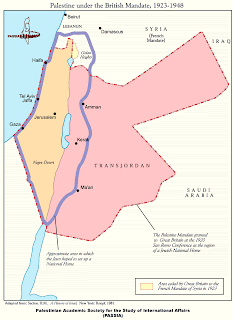 Debusmann then leaps from 1917 to 1945, omitting the seminal event of 1922 when Britain reneged on the original terms of the Palestine Mandate (which had called for a Jewish national home and "close settlement of the land" by Jews) simultaneously lopping off 78 percent of the territory and handing it to the Hashemite Arabs as a gift for their support in the war against the Ottoman Empire while banning Jewish immigration there. That territory -- Jordan today -- has a population which is over 60 percent Palestinian Arab and forbids Jews to reside or own land in the country.
Thus, Debusmann's event summary for 1948 suggesting that Israel retained the bulk of the land is mendacious; indeed it is the Palestinian Arabs who today reside on over 78 percent of the Palestine Mandate, in addition to those Arabs living in Israel.
Along the way to 1948, Debusmann conveniently forgets decades of violent Arab rejection of a Jewish sovereign including events which followed the British Peel Commission call in 1937 for partition of what remained of the Palestine Mandate and of course, the 1948 war which Debusmann refers to in a nondescript passive voice ("U.N. partition plan dissolves in war") making no mention of the declared aim by invading Arab armies to annihilate newborn Israel.
Absent these essential details, it is impossible for readers to fully appreciate the historical context of the conflict -- particularly unyielding Arab hostility to a Jewish state in the region -- and therefore to apprehend the "path to new Israel-Palestinian talks" advertised in Reuters' headline. But of course, facilitating reader understanding is not Reuters' objective.
Indeed, selective reporting is an indispensable component in the Propagandist's toolkit, enabling him or her to lead the reader to a conclusion that has been determined in advance by the writer. By omitting or obscuring key information in a story that would otherwise facilitate a more complete understanding of events and independent analysis, the Propagandist hopes to drive us to adopt, in uncritical fashion, his point of view.Propaganda is persuading people to make up their minds while withholding some of the facts from them.
Take for example, the "Timeline", prepared by Reuters' correspondent Bernd Debusmann (with reporting by Bureau Chief Alastair Macdonald), covering important historical dates in the Arab-Israeli conflict:
Here are key dates on the path to this point:
1897 - European Jews in Zionist movement declare goal of creating a Jewish state in Ottoman Turkish-ruled Palestine.
1917 - British forces take Palestine from collapsing Ottoman empire in World War One. British Foreign Secretary Arthur Balfour declares support for Jewish "national home" there.
1945 - Revelation of Nazi Holocaust and new Jewish migration to Palestine bolster Western support for creating Jewish state.
While a 600-word primer cannot possibly do justice to a topic as complex as the Middle East conflict, Debusmann omits a vast reservoir of essential historical detail, the absence of which substantially distorts the record and gives lie to his event summary for 1948.1948 - Britain quits and great powers recognize Israel as U.N. partition plan dissolves in war that leaves Jewish state on 78 percent of land and half of Palestine's Arabs as refugees.
Although Zionism as an organized political movement arose in Europe in the 19th century, Debusmann makes no mention of the millions of Jews in diaspora -- including some 900,000 Jews living in Arab countries -- who for centuries, had longed for restoration of the ancient Jewish home in and around Jerusalem. Debusmann's note only of "European Jews" is in keeping with the Arab and Reuters narrative of Israel as a product of European colonialism.

Thus, Debusmann's event summary for 1948 suggesting that Israel retained the bulk of the land is mendacious; indeed it is the Palestinian Arabs who today reside on over 78 percent of the Palestine Mandate, in addition to those Arabs living in Israel.
Along the way to 1948, Debusmann conveniently forgets decades of violent Arab rejection of a Jewish sovereign including events which followed the British Peel Commission call in 1937 for partition of what remained of the Palestine Mandate and of course, the 1948 war which Debusmann refers to in a nondescript passive voice ("U.N. partition plan dissolves in war") making no mention of the declared aim by invading Arab armies to annihilate newborn Israel.
Absent these essential details, it is impossible for readers to fully appreciate the historical context of the conflict -- particularly unyielding Arab hostility to a Jewish state in the region -- and therefore to apprehend the "path to new Israel-Palestinian talks" advertised in Reuters' headline. But of course, facilitating reader understanding is not Reuters' objective.
Wednesday, March 3, 2010
More Reuters errata and broken boilerplate
In a story about the Arab League agreeing to support "indirect" negotiations between Israel and the Palestinian Arabs, Reuters digs into the broken boilerplate bin and comes up with:

No. As we have documented numerous times, negotiations had effectively ended months prior to the war in Gaza when Abbas refused then Israeli PM Ehud Olmert's offer of 97% of the "West Bank" (also, Judea and Samaria) for a comprehensive peace settlement; when the Palestinian Arabs were unable to coerce the Quartet to stipulate that a Palestinian state be set up on the 1949 Armistice Lines with Jerusalem as their capital; and due to imminent elections in Israel. Abbas supported Israel's efforts in Gaza to rid the strip of Hamas:[PA President] Abbas broke off talks with Israel to protest its offensive in Gaza launched in December 2008.
Reuters continues with more false assertions:At the start of Israel's offensive, one of Abbas' top aides said Hamas was "110 per cent" to blame for the Gaza attack — an unpopular, if not suicidal, stance among Palestinians, whose ire was directed at Israel. Even as the civilian death toll climbed, Abbas delayed several days before criticizing the Israeli offensive. In the West Bank, which Abbas controls by dint of the presence of the Israeli army, his security forces cracked down brutally on fellow Palestinians protesting the Israeli offensive. Palestinians ask why Abbas did not go to Gaza during the fighting to show solidarity with its residents, or organize blood or food help for Gaza's victims.
No. Abbas has insisted that Israel halt building on all land outside of the 1949 Armistice Lines including land which is and has been legally owned by Jews going back over eighty years.He [Abbas] has resisted U.S. and Israeli calls for a resumption of direct negotiations, saying Israel must first halt all Jewish settlement building on occupied lands where the Palestinians aim to establish a state.

Thursday, February 25, 2010
Reuters corrects error; hopes no one notices
In a prior post, we noted Reuters correspondent Nidal al-Mughrabi erred when he reported that:
In violation of its Handbook of Journalism, Reuters fails to correct this error openly but in a story appearing today about Hamas arms trafficker Mahmoud al-Mabhouh, Reuters' al-Mughrabi is careful not to repeat the same mistake:
 Yes, we understand that Hamas has recently agreed to purchase on installment, Persian rugs for the mansion Ismail Haniyeh will be building in Gaza.
As documented in our post at the time and as reported by the Associated Press, Iran has, in fact, admitted to bankrolling Hamas.Iran says its support for Hamas is diplomatic only.
In violation of its Handbook of Journalism, Reuters fails to correct this error openly but in a story appearing today about Hamas arms trafficker Mahmoud al-Mabhouh, Reuters' al-Mughrabi is careful not to repeat the same mistake:
Amusingly however, al-Mughrabi apparently now wishes readers to believe that Iranian financial support for Hamas may be for other than weapons:Both Hamas and Iran have acknowledged Tehran's financial support for the group [Hamas]...
... while stopping short of confirming Israel's belief that this includes bankrolling arms smuggled to the Gaza Strip.

Subscribe to:
Posts (Atom)