Friday, January 14, 2011

Serial liar and racist Tom Perry back from his holiday

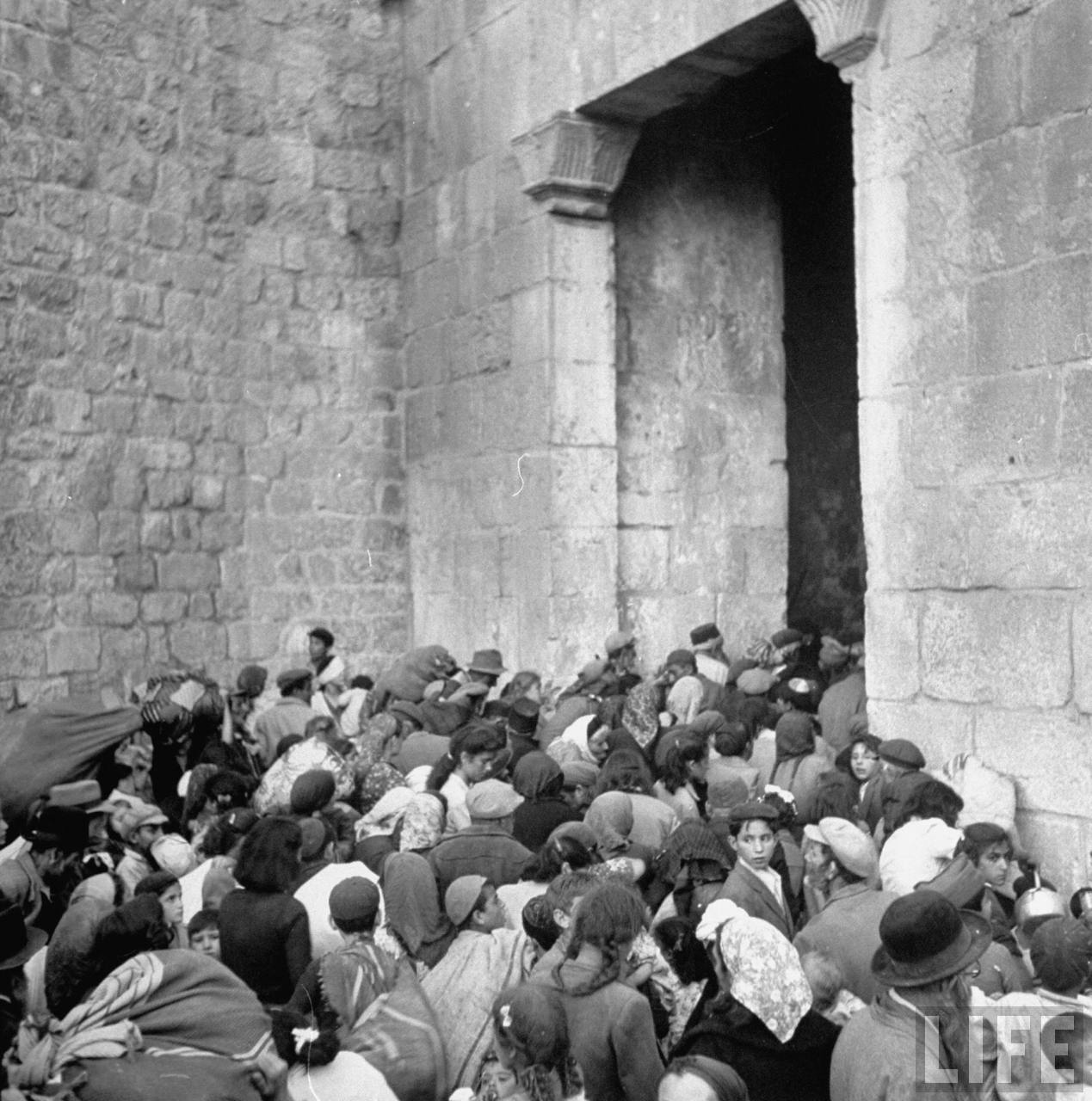
Reuters correspondent Tom Perry is back from an extended holiday and obviously feeling reinvigorated, he returns to his long tradition of lies and racism targeting the Jews of Israel.  In a story about Arab businessmen investing in Jerusalem, Perry sycophantically parrots Reuters' deep-pocketed Arab clientele, referring to the eastern portion of Jerusalem, the Old City where Jews were ethnically cleansed by the Arab Legion following Israel's War of Independence in 1948, with the ahistorical and racist misnomer "Arab East Jerusalem".  This, in a transparent bid to displace and reassign ownership of Jerusalem, a city built by the Jews and only ever sovereign to a Jewish state, to the descendants of Arab invaders and colonizers.

Perry next compares the business and economic climate in the Palestinian capital of Ramallah with that of Jerusalem:
For many, it has been easier to invest in Ramallah, the nearby West Bank city governed by the Palestinian Authority. Lower taxes and cheaper labor add to the business case. Ramallah is booming, thanks largely to Western donor support.  By contrast, economic life in East Jerusalem's walled old city and nearby Arab districts, home to some 350,000 Palestinians, has been suffocated by the impact of the barrier built by Israel during the last Intifada, or uprising.
Perry is lying here, inflating the Arab population of greater Jerusalem by 40 percent and asserting that the economy in the eastern portion of the city has been "suffocated" by the security fence, built by Israel to prevent Palestinian suicide bombers from reaching the civilian population.  In fact, Jewish districts in eastern Jerusalem lag the country in economic growth as well and the percentage of Arab households with employed persons (76.1%) is actually higher than that of Jewish households (66.8%).  The relatively high rate of unemployment and poverty in Jerusalem is due to a multitude of complex factors, not the least of which is the large Haredi population in the city, 70 percent of whom choose religious studies over work.  And of course, if the Palestinian Arabs wish for Israel to remove the security barrier, they simply have to choose peace over terror.

Having embraced the Arab-designated name for the eastern portion of Jerusalem in violation of the Reuters Handbook of Journalism, Perry then embraces Adnan al-Husseini as the "Palestinian Authority-appointed governor of Jerusalem":
"Jerusalem should not just be the focus of songs and poetry. Today, Jerusalem is about work. People who want to protect Jerusalem must work in it. Israel is working hand over fist and putting in billions. The Arab nation must spend more," he said.
Al-Husseini is actually not the "governor" of Jerusalem, but rather Palestinian president-for-life Mahmoud Abbas' adviser on Jerusalem affairs.  And although Perry uncritically parrots Husseini suggesting that only Israel is investing heavily in Jerusalem, in fact, the "Arab nation" is quite active in that regard, having poured hundreds of million of dollars into illegal construction.

Thursday, January 13, 2011

Non sectarian or non sequitur?

Writing about the political chaos in Lebanon following the resignation of all Hezbollah-affiliated government ministers, Reuters correspondent Mariam Karouny slips in this amusing whopper and non-sequitur:
Hezbollah portrays itself as spearheading Islamic resistance to Israel, not as a sectarian group.
Our desktop dictionary defines sectarian as:

1. of or pertaining to sectaries or sects.
2. narrowly confined or devoted to a particular sect.
3. narrowly confined or limited in interest, purpose, scope, etc. 

Hezbollah, a Shiite group, has previously done battle with the Sunni community in Lebanon and incites for genocide against the Jews.

But for Mariam Karouny, the group's image is one of simply "spearheading Islamic resistance to Israel" (note the Arab euphemism for murder) and not sectarian.

This is what happens when journalists learn their craft under the tutelage of Chris Patten.

Tuesday, January 11, 2011

Reuters quite sure on Israeli UNSC violations. On Lebanese violations, agency hasn't a clue

In a story on the Lebanese prime minister meeting with UN Secretary General Ban Ki-moon to urge the UN to pressure Israel on a variety of fronts, mendacious Reuters correspondent Louis Charbonneau is sufficiently confident of Israeli violations of UNSC resolution 1701 to cite them as such, but apparently completely in the dark about Lebanon's violations of the same:
In a one-hour meeting with U.N. Secretary-General Ban Ki-moon at a New York hotel, Lebanese Prime Minister Saad al-Hariri insisted on the "full implementation of U.N. Security Council resolution 1701," a member of Hariri's delegation told Reuters on condition of anonymity.
U.N. Security Council resolution 1701 halted hostilities in the Israeli-Hezbollah war in 2006 and banned all unauthorized weapons between the Litani River and the Blue Line, the U.N.-monitored border between Israel and Lebanon.
It also called on Israel to halt unauthorized flights over Lebanese territory, though the United Nations says the Jewish state regularly sends aircraft over Lebanon.
Note how Charbonneau accurately cites UNSC 1701 but is mute on whether Lebanon is actually abiding by the resolution.  Charbonneau seems to have forgotten his own report from a year ago on the discovery by UN peacekeepers of hundreds of pounds of explosives just within the Lebanon border with Israel as well as scores of other reports documenting the tens of thousands of missiles supplied to Hezbollah in violation of UNSC resolution 1701, UNSC resolution 1559, and UNSC resolution 1680.

Charbonneau apparently suffers from the same infirmity of selective amnesia as his colleagues at Reuters.  Must be something in the water cooler.

Sunday, January 9, 2011

Jeffrey Heller forgets a little something

One of the most pernicious forms of propaganda is known as card stacking or selective omission.  Here, the propagandist deliberately omits certain key facts or other information that would otherwise provide his audience with a more complete understanding of a situation and be able thus, to form an independent opinion free of manipulation by the propagandist.

Take for example, a story by Reuters Jerusalem Editor-in-Charge Jeffrey Heller on Israel's redevelopment of the Shepherd Hotel compound.  Heller proffers a cursory history of the subject property as follows:
In the predominantly Arab neighborhood of Sheikh Jarrah, bulldozers tore into the decaying hotel built in the 1930s for Muslim grand mufti Haj Amin Husseini, who fought the British and Zionists and became a World War Two ally of Hitler.
A project to replace the building with a block of 20 apartments was approved by Israel's Jerusalem city hall in 2009...
The hotel was declared "absentee property" by Israel after it captured and annexed East Jerusalem. The title was transferred to an Israeli firm, which sold it in 1985 to Irving Moskowitz, a Florida bingo king and patron of Jewish settlers.
Adnan Husseini, the Palestinian Authority-appointed mayor of Jerusalem, said knocking down the historic building was an "act of barbarism."
His family claim ownership of the property and had been using the Israeli courts to challenge the steps that had led to its sale.
Heller leaps from the 1930s when the structure was originally built for Palestinian Nazi collaborator and uncle to Yasser Arafat, Haj Amin al-Husseini, to the year 1967 when the hotel came into Israeli hands following the Six-Day War.  Omitted from Heller's synopsis, are a few salient details:
When the British Mandate government deported him [al-Husseini], the building was confiscated and turned into a military outpost for the British Army. At the end of the period of the British Mandate, the building was transferred to the ownership of the Hashemite Kingdom of Jordan, which expanded the original structure without affecting it, and the building served as the Shepherd Hotel.
Following the Six Day War, the hotel became the property of the Government of Israel. It was used by the Ministry of Justice and as a district courthouse.
On November 5 1985, C and M properties purchased the building and surrounding land from the Government of Israel. With the beginning of the first Intifada in 1987, the Border Police leased the building and stayed there for about 15 years before moving to their new building alongside Highway One.
Note that during the entire period, 1948 to 1967, during which time the property was in the hands of, first, the British and then the King of Jordan, there was absolutely no dispute by Adnan Husseini or anyone else over ownership.  Only after Israel took possession of the compound did Husseini and the Palestinians become incensed and seek to obtain title.

Heller also uncritically parrots Husseini's assertion that Israel is "knocking down a historic building" as "an act of barbarism".  Actually, the developers have agreed to retain a portion of the original structure for historic preservation purposes.  We think this an extraordinarily charitable gesture; after all, how many civilized people would object to the razing of a derelict hotel built for a Nazi-collaborator who once beseeched:
"Arabs, rise as one man and fight for your sacred rights. Kill the Jews wherever you find them. This pleases God, history, and religion.  This saves your honor.  God is with you".

Saturday, January 8, 2011

A tale of two tales

Compare the following two headlines from stories published by Reuters on its website today: 

Israeli troops shoot dead Palestinian
in West Bank
 
Gaza mortar shell wounds two men
at Israeli farm

In the first headline, Reuters clearly identifies both parties to the incident: a Palestinian is shot by Israelis.  In the second headline, two men are wounded by a mortar shell apparently fired by someone named "Gaza".  It's not until the 4th paragraph of a seven paragraph story written by correspondents Ori Lewis and Nidal al-Mughrabi that we learn the identity of the perpetrator of the violence, Islamic Jihad, and even here, there is no mention that this is a Palestinian group.

But Dean Wright, Reuters Global Editor for Ethics, Innovation and News Standards, advises us to "be honest and transparent with your audience".

Proverb: the counsel you would have another keep, first keep yourself

Regular readers of RMEW will be familiar with the Reuters Trust Principles and the agency's Handbook of Journalism.  We refer to these frequently to illustrate the way Reuters correspondents regularly violate their own corporate governance charter and ethical guidelines with patent partisanship and skewed reporting.

Dean Wright is Global Editor, Ethics, Innovation and News Standards for Reuters.  On the Reuters website, Wright's bio reads:
"He leads the process of reviewing, establishing and encouraging adherence to standards in Thomson Reuters journalism and works with editors to promote innovation. He writes a regular column and works with Editor in Chief David Schlesinger in maintaining the editorial relationship with the Reuters trustees and upholding and promoting the Reuters Trust Principles."
We recently discovered two interesting videos of Wright talking about online journalism ethics and the Reuters handbook, respectively.


Friday, January 7, 2011

Independent news agency or dishonest political advocate?

Reuters' many stories disparaging the current Israeli government reflect nothing less than the agency's contempt for democracy as the Jewish people seek to protect their lives, land, traditions, and national rights in the face of a relentless effort to drive them from the Middle East.  Reuters is not merely engaged in political advocacy in this regard but in crafty chicanery as well. 

Note how in the following story, correspondent Dan Williams slyly leads his audience from what would be a straightforward report on Israeli Prime Minister Netanyahu being interrupted by bereaved relatives during a memorial speech, to innuendo suggesting, falsely, that the Netanyahu government has been subject to regular public censure, to an entirely unrelated and specious reference asserting that major powers have rebuked Netanyahu for the collapse of peace talks with the Palestinians:
(Reuters) - Prime Minister Benjamin Netanyahu's memorial speech for those killed in Israel's worst-ever wildfire was disrupted on Wednesday when bereaved relatives shouted for his interior minister's ouster.
Bodyguards briefly sheltered Netanyahu as a few dozen hecklers surged toward him and others stormed out of the event at Beit Oren, a kibbutz at the epicentre of last month's Carmel forest blaze in which 44 people, mostly rescue personnel, died.
Interior Minister Eli Yishai, who as the official responsible for Israel's fire services bore the brunt of public outrage at the disaster, left the hall after the first outbursts against him. Netanyahu then resumed his speech.
"My heart is with you," he said. "I understand the pain."
The upset was a fresh public rebuke for Netanyahu's rightist coalition government, in which Yishai's Shas, a party run by rabbis, is junior partner. Many secular Israelis have long opposed Shas policies on welfare and other core social issues.
But the broad-based government has weathered such domestic censure as well as criticism from world powers trying to break a deadlock in Israeli-Palestinian peace talks that followed Netanyahu's refusal to renew a freeze on West Bank settlements.
Indeed, despite an approval rating of about 38 percent, the latest poll shows the Israeli public supporting the Netanyahu government by nearly two-to-one over opposition leader Tzipi Livni and her Kadima party.  And although Interior Minister Eli Yishai is not popular, the same poll found that if Aryeh Deri headed Shas, the party would win 15 seats in the Israeli parliament, compared to the current 11.

Williams goes on to provide not a shred of evidence for his assertion that "world powers" have criticized Netanyahu for his stance on the settlement freeze.  In fact, following numerous failed attempts to persuade the Palestinians to continue in direct peace talks, the US formally dropped its request for an extension of the freeze stating that "[we] have determined a moratorium extension at this time will not provide the best basis for direct negotiations".

Though Williams and Reuters work tirelessly, with deceit and malice, to demonize the Israeli government and its policies, the Israeli public apparently takes a somewhat different view.  And this includes a recognition of who, precisely, is to blame for the "deadlock" in Israeli-Palestinian peace talks.

Wednesday, January 5, 2011

The new year, same as the old year

Of one thing we can be certain: Reuters correspondents have not made any New Year's resolutions giving up their addiction to injecting anti-Israel propaganda into their stories.  In a piece on Russian President Dmitry Medvedev canceling his visit to Israel, Douglas Hamilton tosses in this bit of vintage 2010 boilerplate:
Direct talks began in September between Israeli Prime Minister Benjamin Netanyahu and [Palestinian President] Abbas. But the process foundered in a matter of weeks over Israel's refusal to extend its freeze on building at Jewish settlements in the occupied West Bank.
Like his colleagues at Reuters, Hamilton blames Israel, and only Israel, for the collapse of negotiations.  There is no mention of the fact that Abbas tarried for nine and a half months of the original ten-month building moratorium, trying to extract further unilateral concessions from Netanyahu before agreeing to talk.  No mention of the fact that Abbas told his party that he would not make a single concession in negotiations with Israel.  And no mention of Abbas' adamant refusal to recognize Israel as a Jewish state, as did the United Nations 63 years-ago, in exchange for a Jewish construction freeze in the territory.  These are glaring omissions clearly intended to mislead and manipulate readers into adopting Hamilton's personal pro-Palestinian political views and as such, they represent an egregious violation of the Reuters Handbook of Journalism and the company's Trust Principles.

Hamilton also adds to the three-year running total of 1,130 Reuters stories (over one per day) employing the propaganda mantra, "occupied West Bank", so named in part, following Israel's liberation of the territory from Jordanian occupation in 1967 and in part, following Arab ethnic cleansing of Jewish communities from the territory in the previous Arab-Israeli war.  Hamilton sycophantically serves Arab interests in this regard, refusing to balance the "West Bank" designation with Israel's appellation for the territory, Judea and Samaria.  This, a violation of Reuters social responsibility commitment:
We must be on alert for language that could imply support for one side of a conflict, sympathy for a point of view, or an ethnocentric vantage point. We should, for example, provide the dual names of disputed territories. We must not parrot any loaded expressions used by our sources, except in quotes and official titles. Generic references to a specific country as “the homeland” for example, are unwelcome.
In 2009 and 2010, Douglas Hamilton repeatedly demonstrated his contempt for the Thomson Reuters Trust Principles and professional standards of conduct for a purportedly unbiased news agency.  The question at hand, is whether Reuters will enable him to continue to display that contempt through 2011.

Tuesday, January 4, 2011

The Ghost of Christmas Past

In the run-up to Christmas each year, Reuters is notorious for penning stories that depict hardship and gloom amongst Palestinians living in and around Bethlehem.  And blaming that despondency on -- you guessed it -- Israel.  We commented on several of these stories in 2009, pointing out that Reuters employs its usual holiday bag of propaganda devices, deceit and omissions to maliciously smear the Jewish state.

This past Christmas however, we noticed a marked dearth of such stories from the usual suspects and we think we have discovered the reason why: a group of Jerusalem-based reporters were so fed-up with the annual insipid ritual, they started a Facebook group called Reporters against whiny christmas stories in Bethlehem:
A rebel group of Jerusalem-based reporters has reacted to the decade-long tradition of Bethlehem holiday stories by refusing to accept any holiday cheer this season.
Refusing editors' requests for "Christmas in the holy land" tales of Palestinian woe and tourist shows, the group has announced it will refrain from filing any articles until an actual news event occurs.
"We are doing this for the good of our readers. Who, if they have any memory whatsoever, will recall that we have written the exact same Bethlehem story for the past four years," said a spokesman for the group. He continued that the decision was also financial, hoping to save the dying newspaper industry the cost of commissioning a new piece when they could just rewrite the previous versions.
One journalist, who asked to remain anonymous, said the rebel group was trying to quell more extreme elements who called for a torching of all olive-wood products made in Bethlehem, and the expelling of shopkeepers who whined excessively.
 Heh!

Reuters still running interference for Iran

Over the seventeen months we have been commenting on Reuters Middle East coverage, the agency has published hundreds of articles on Iran and its nuclear program.  In all but a handful of these stories, Reuters correspondents refuse to come clean with respect to the overwhelming global consensus, led by the IAEA at the United Nations, that Iran is pursuing nuclear weapons.  Rather, the agency hypnotically repeats one of its favorite propaganda mantras that merely the US and Israel, or alternatively, the amorphous "West" are making this claim:
Iran is at odds with major powers over its nuclear activities, which the United States and its allies suspect are aimed at producing a nuclear weapon. Tehran has denied the allegations and said it wants only to generate electricity.
Framed this way, the scope of Iran's nuclear program (as well as its serial violations of the Nuclear Proliferation Treaty) is always in murky waters, one of subjective debate, unsupported claim and denial, between Iran and her adversaries.

Reuters apparently hasn't a clue as to whether any independent evidence has emerged -- like this, this, or this -- to confirm American "suspicions".

Alternatively, why does Reuters, an agency that trumpets itself as the foremost source of "unbiased and reliable news", continue to deliberately conceal the facts about Iran's nuclear program?

Saturday, January 1, 2011

Reuters conceals true nature and history of Fatah

Reuters correspondents Ali Sawafta, Allyn Fisher-Ilan, and Mohammed Assadi begin the new year the same way they began the previous year -- by providing cover for Palestinian President Mahmoud Abbas.

In a story on Palestinian demands for the Quartet (the US, EU, Russia, and the UN) to draft a new "peace plan" which calls for a Palestinian state on all disputed land outside the 1949 Armistice Lines, the Reuters trio cite Abbas speaking on television yesterday:
Abbas, speaking on the anniversary of the foundation of Palestinians' mainstream Fatah movement, reiterated a demand for Israel to halt settlement building, the issue over which negotiations launched anew in September foundered just several weeks later.
In fact, the occasion was not the anniversary of the "foundation" of Fatah, but rather the 46th anniversary of the group's first attempted bombing attack.  Apparently, a minor detail missed by Reuters.

Note also, that this terror attack occurred on January 1st, 1965, two years prior to Israel gaining control of Judea and Samaria (the "West Bank") in the Six Day War and the commencement of modern settlement construction, the fictitious casus belli advanced by the Arabs and their media acolytes to rationalize Palestinian terrorism aimed at Jewish civilians.

Reuters does get one thing right: Fatah's raison d'etre and bloody methods are indeed "mainstream" in Palestinian society.

hat tip: EoZ

Wednesday, December 29, 2010

It's a bird; it's a plane; it's Ultra-N Man!

Our desktop dictionary defines an ultranationalist as: one who has extreme devotion to or advocacy of the interests of a nation, especially regardless of the effect on any other nations.
  
This is how Reuters correspondents systematically characterize Israeli foreign minister, Avigdor Lieberman (when they are not referring to him as "fiery").  It is, of course, a form of name calling, a well-worn propaganda device intended to slap down a public figure with a cheap label and thus elicit a negative emotional reaction to that person from an unsuspecting audience.

Jerusalem Bureau Editor-in-Charge Jeffrey Heller continues the Reuters tradition in a story about Israeli Prime Minister Benjamin Netanyahu's response to comments made by Lieberman regarding Israel's relations with Turkey and prospects for a peace deal with the Palestinian Arabs:
Prime Minister Benjamin Netanyahu, trying to keep his coalition intact before a vote this week on Israel's budget, has opted to play the diplomat in a flare-up with his fiery foreign minister, Avigdor Lieberman.
Commentators accused Netanyahu of kowtowing to the ultranationalist Lieberman at the expense of Israel's international image, but agreed a coalition crisis had been averted for now and predicted the budget would pass.
In blunt public remarks on Sunday, Lieberman said Israel would not apologize to Turkey over the killing of nine Turks by Israeli commandos during a raid on a Turkish ship trying to break a Gaza blockade in May.
Pouring scorn on the stalled peace process with the Palestinians, Lieberman told a meeting of Israeli diplomats a permanent peace agreement was impossible and the best option would be "Plan B," a long-term interim accord.
The comments seemed at odds with Netanyahu's stated desire to patch up relations with Turkey and U.S. efforts to keep alive a peace effort that has foundered on his refusal to extend a partial freeze on Jewish settlement building in the West Bank.
Note how Heller attempts to shift responsibility for his own editorializing with a reference to anonymous "commentators" allegedly doing the name calling, a violation of the Reuters Handbook of Journalism.  Heller then editorializes further, characterizing Lieberman's suggestion for an alternative interim accord with the Palestinians as "pouring scorn on the stalled peace process".  We've not seen Heller employ similar language to describe recent talk by Palestinian leaders of their "Plan B".

Heller blames Netanyahu, and by implication, Israel, for the failure of peace talks by pointing to the expired ten-month building moratorium for Jews in Judea and Samaria (the "West Bank") when it was Palestinian President Mahmoud Abbas who filibustered on negotiations for over nine months and walked away entirely when the moratorium ended in September.

Only in the Orwellian realm of Reuters Jerusalem Bureau can Palestinians like Abbas, Saeb Erekat, and Nasser Al Kidwa, who demonstrate the most uncompromising positions on national rights, be caressed as political "moderates" and "pragmatists" while Israelis like Lieberman are blackened with the "ultranationalist" tag.

Friday, December 24, 2010

"Nearly 500,000 Jews live on land captured by Israel in the 1967 war"

The above quote is from a Reuters story written by Mohammed Assadi and Ori Lewis.  We cite it because it is typical of the many propaganda mantras Reuters correspondents embed in their stories to portray Jews in a negative light and advance Palestinian Arab interests.

While it is true that approximately 500,000 Jews live in the eastern portion of Jerusalem and the last unallocated portion of the Palestine Mandate, in its relentless effort to persuade its audience that Jews are interlopers and colonizers of Arab land, Reuters employs the language of conquest to "explain" how the Jews got to living there.  Per Reuters' vision you see, there happened to have been a war in 1967 fought by Israel -- against whom and for what reasons, we are never told -- that resulted in Israel capturing land purportedly the property of the Palestinian Arabs and the subsequent illegal influx of 500,000 Jewish settlers to the area.

In none of its stories on the matter, does Reuters inform its readers that Jews had settled the same area over three-thousand five hundred years ago; that Jews built Jerusalem as a sovereign and sacred city; that the area was repeatedly invaded and conquered by other tribes and nation-states with many millions of Jews killed and ethnically cleansed; that despite this long and bloody history, Jews maintained a continuous presence on the land for over three millennium culminating in their constituting a majority of the Jerusalem population by 1840; that both the League of Nations and the United Nations granted Jews the right, under international law, to settle anywhere in Palestine west of the Jordan River; that local Arab mobs ruthlessly sought to prevent Jews from exercising this right by perpetrating regular pogroms and massacres against the Jewish community; that the Arab states invaded the nascent state of Israel in 1947 in a declared war of annihilation successfully conquering the remaining portion of Palestine and the Old City of Jerusalem from whence the Jews were once again ethnically cleansed; and that the Jews only once again, recovered their rights and land in the area following that "1967 war" instigated by the Arabs in yet another attempt to eradicate the state of Israel.

Provided with the historical facts rather than peremptory propaganda, Reuters readers would be much better served and able to understand and assess the Middle East conflict in an informed and non-coercive manner.

Tuesday, December 21, 2010

Obfuscation

As we have previously noted, Reuters documents the Middle East conflict as if it were a one-sided tennis match.  The Palestinian Arabs launch a rocket or mortar attack on an Israeli village and Reuters frequently fails to cover the story unless and until Israeli forces retaliate.  When the latter occurs, you can be sure that Reuters will be the first wire service out of the gate with full coverage and an unambiguous headline akin to:
Israel bombs Gaza tunnel near Egypt
Now compare the above with the following headline appearing in a story written by Reuters correspondent Douglas Hamilton about a Palestinian rocket exploding within 30 feet of an Israeli kindergarten and nursery schools causing injury to a teenage girl:
Kindergarten near-miss highlights Gaza risks
Note how Hamilton willfully obfuscates the facts, failing to cite either the nature of the incident (a rocket attack) or the perpetrator (Palestinians).  It's not until the 8th paragraph down in his story that Hamilton finally gets around to informing readers that the attack was claimed by the Palestinian group Army of Islam, although even here, Hamilton refuses to use the word "Palestinian".  Indeed, Hamilton immediately follows this apparently inconsequential piece of information identifying the perpetrator with the unsupported and ridiculous assertion that:
Hamas leaders have tried to curb rocket fire at Israel from Gaza in recent years, but smaller groups continue to carry out attacks.
Hamilton has been conducting PR on behalf of the Palestinians for years and here he does the same for the genocidal Hamas.

Finally, note the embedded photo which depicts not the subject of the story, the Palestinian rocket attack on an Israeli kindergarten, but the damage resulting from the retaliatory Israeli strike in Gaza.

All in a day's work for the propagandists at Reuters.

Sunday, December 19, 2010

Reuters cites Saudi-funded HRW to demonize Israel

As we noted here, Reuters correspondent Ori Lewis follows the company line when it comes to systematic violations of the Reuters Handbook and the use of propaganda devices in an effort to delegitimize Israel.

In his latest project, Lewis trumpets his story with the headline:
Israel deprives Palestinians in West Bank 
Lewis has a nasty habit of asserting claims from NGOs, particularly discredited NGOs, as fact and only later in his stories explaining that these are merely disputed claims.  And the Reuters correspondent apparently never does his own fact-checking on these claims, nor does he provide readers with background material on the NGO making accusations which might otherwise cast doubt on the credibility of the organization behind the claims.

So, we'll do Lewis' job for him.

The NGO cited by Lewis in this story is Human Rights Watch (HRW) which, as we have documented, solicits and receives a portion of its funding from groups and nation-states which are openly hostile to Israel's very existence.  HRWs own founder, Robert L. Bernstein, has condemned the NGO for irrational anti-Israel bias.  HRW directors were last seen objecting to Israel's call for full transparency with respect to their funding sources.

Now let's have a look at the material aspect of HRWs claims against Israel:
"Israeli policies in the West Bank harshly discriminate against Palestinian residents, depriving them of basic necessities while providing lavish amenities for Jewish settlements," the New York-based organization said...
... Carroll Bogert, a spokeswoman for the group, said Israel was carrying out "systematic discrimination merely because of (Palestinians') race, ethnicity and national origin, depriving them of electricity, water, schools and access to roads."
These are serious charges which, as a purportedly objective reporter for the largest news agency in the world, Lewis should be investigating rather than simply parroting.  Had he done so, Lewis would have discovered (and presumably reported) that first, Israel is not responsible for providing "basic necessities" to Palestinians living in the "West Bank".  Those Palestinians classified as "refugees" are supported by the United Nations Relief Works Agency (UNRWA) which is funded to the tune of over a billion dollars annually, coming mainly from US and European taxpayers.  Indeed, the Palestinians receive more aid money than any other refugees in the world.  As well, Palestinians not classified as refugees are the responsibility of the Palestinian Authority under Mahmoud Abbas and work for their basic necessities, as do Israelis.  The government of Israel is not "depriving" anyone.

With respect to infrastructure like electricity and water, Israel has spent billions of dollars since 1967 building and supplying electrical power and clean drinking water to both Jewish and Arab communities in the territory.  That HRW cites a single Arab village with 150 denizens which cannot apparently get connected to the electrical grid (for security reasons) is hardly evidence of, "systematic discrimination... because of (Palestinians') race, ethnicity and national origin", which after all, is the same as that of millions of other Palestinian Arabs in the West Bank who are connected to the power grid.

Wednesday, December 15, 2010

Reuters relocates capital of Israel

On AlertNet, "the world's humanitarian news site", Reuters provides news along with free and unfettered story publication rights for hundreds of NGOs, many of which are partisan and heavily politicized.  Today, we noticed that the Reuters AlertNet website has recently undergone a face-lift and on the profile page for Israel, we learn that the capital of the country is... wait for it... Tel Aviv.

Related country profile

Israel  
Capital:Tel Aviv
Currency:Shekel (ILS)
Time zone:GMT +2

Of course, Israel's capital city is not Tel Aviv, but Jerusalem.

Perhaps Reuters Jerusalem Bureau is actually in Tel Aviv as well.

UPDATE DECEMBER 16, 2010: Reuters has had a sudden change in heart and Israel's capital is now indicated as "in dispute".

Word has it that Reuters considers Israel's existence as falling into the same category.

Tuesday, December 14, 2010

Police brutality!

Reuters often accompanies its stories on the Middle East conflict with video footage, carefully edited and narrated to influence its audience to adopt the news agency's political views.  Then again, Reuters sometimes misses the opportunity to provide exemplary video when it might otherwise distract from the agency's biased messaging.  Take for example, this story by Reuters correspondent Jihan Abdalla on Palestinian Arab children throwing rocks at Jews driving through the Silwan neighborhood of Jerusalem.  Abdalla reports that:
Seemingly heedless of the risk they pose their targets and themselves, the youngsters also goad local Israeli security forces determined to keep order...
There are no flags, posters or political slogans in these encounters, but a lot of youthful bravado suggesting that even juveniles feel they must confront "the occupying power."...
In October, tensions spiked again after a Silwan settler leader -- who later said he had simply panicked -- drove his car right into a group of rock-throwing boys, knocking one over.
What Abdalla doesn't tell her readers, is that in many cases, these "youngsters" are being groomed and directed to engage in rock-throwing by adults, often members of Palestinian President Mahmoud Abbas' Fatah party.  And that reporters and photographers are being invited to record the incidents so as to provide propaganda fodder for the Palestinians.  Have a look at this independent documentary video of the incident Abdalla describes above:


Abdalla then attempts to make the case (with lots of help from B'Tselem) that Israeli police are being too tough on Palestinian minors by detaining and handcuffing them following such incidents.  Afforded video evidence however, Reuters' audience might come away with a somewhat different view.

Parroting lies

In an Op-ed "Analysis" on the latest failure in negotiations between Israel and the Palestinian Arabs, Reuters curly-haired perfume peddler, Crispian Balmer uncritically quotes former Yasser Arafat propaganda minister, Yasser Abed Rabbo on the failure of the United States to broker a deal between the warring parties:
If the United States could not get Israel to halt settlement "for a limited period," how would it be able "to make Israel accept a balanced solution on the foundation of international resolutions and the two-state solution?," he asked.
But of course, the US did get Israel to formally halt settlement building in Judea and Samaria (the "West Bank") for ten months and, on a de facto basis, for the same ten months in Jerusalem as well.  The Palestinian Arabs, on the other hand, refused to enter into negotiations with Israel based on that unilateral and unprecedented concession until three weeks remained in the moratorium.

How about the notion then, that Israel has failed to "accept a balanced solution on the foundation of international resolutions and the two-state solution"?

Well, let's see...

Israel's Prime Minister accepted the internationally-sanctioned "two-state solution" in June of 2009.

And Israel has, for over 43 years, repeatedly demonstrated its good faith efforts to comply with international resolutions by withdrawing from captured land and attempting to return captured land while securing for itself "territorial integrity and political independence" along with the "right to live in peace within secure and recognized boundaries free from threats or acts of force" as stipulated by UNSC Resolution 242.

So Rabbo's statement is false, and Balmer merely parrots when his lede suggests he should be analysing.

Sunday, December 12, 2010

Reuters cannot find Sanremo on the map

In addition to being a lovely holiday resort on the Italian Riviera, Sanremo is the spot where Allied Powers of World War I met in 1920 to disposition (not really a verb but apropos here) the territory of the vanquished Ottoman Empire.  The resolution arising from the San Remo conference called for the recognition of sovereign states of Syria and Mesopotamia (modern-day Iraq) and a Jewish national home in Palestine.  It mandated that:
The Administration of Palestine, while ensuring that the rights and position of other sections of the population are not prejudiced, shall facilitate Jewish immigration under suitable conditions and shall encourage, in co-operation with the Jewish agency referred to in Article 4, close settlement by Jews on the land, including State lands and waste lands not required for public purposes.
The San Remo resolution became international law on July 24, 1922 when it was adopted by the League of Nations and subsequently grandfathered across to the League's successor, the United Nations. 

In 1947, the British abandoned their responsibility as Administrator of the Palestine Mandate and the UN recommended partition of the remaining land (78 percent had already been given away to the Hashemite Arabs) between Jews and Arabs living west of the Jordan River.  The Arabs violently rejected partition and the rest, as they say, is history.

For Tom Perry and the babes at Reuters however, history only begins in 1967:
Israel has settled the territory extensively since 1967, when it captured and occupied the West Bank and the Gaza Strip. The international community for the most part deems the [Jewish] settlements illegal. 
Settler leaders claim a biblical right to the West Bank.
It is undoubtedly true that many Jewish settlers in Judea and Samaria (the "West Bank") feel the 3,500 year history of Jewish civilization and culture in the territory, as documented in both the Bible and the archaeological record, well-qualifies them to live there.  At the end of the day however, it is contemporary international law, embodied in San Remo and still on the books at the United Nations, which guarantees that right.

Saturday, December 11, 2010

Every trick in the book

In a story on Israel's announcement of homes to be built in the community of Pisgat Zeev, Reuters correspondent Ori Lewis incorporates a variety of propaganda devices, deceptions, apologetics, racism -- oh, and a libelous information source -- to damn Israel in the minds of readers:
JERUSALEM (Reuters) - Israel on Wednesday revealed plans to build new homes on West Bank land it has annexed as part of its Jerusalem boundaries, a move likely to further hamper any resumption of peace talks with the Palestinians.
Lewis repeatedly violates the Reuters Handbook of Journalism in this piece by referring to the last unallocated portion of the original Palestine Mandate with its Arab-designated term, "West Bank" while failing to balance this with Israel's appellation for the disputed territory, Judea and Samaria.  He then goes a step further by employing the ahistorical and racist term, "Arab East Jerusalem", to describe the eastern portion of the city of Jerusalem abutting the community of Pisgat Zeev.

Lewis then scoffs:
Pisgat Zeev, founded 25 years ago, is one of its largest Jewish "neighbourhoods," as Israel refers to it, with some 50,000 inhabitants.
because Israel doesn't accept Reuters' utterly bizarre view that a community of 50,000 people living on land adjoining Jerusalem, an area the archeological record shows was a producer of wine and oil for use in the Jewish Temple in the city, is anything other than, (gracious!), a neighborhood.

Lewis continues:
Israel has insisted that building in the urban areas it annexed to Jerusalem following their capture in a 1967 Middle East war were never included in the freeze.
Why cast doubt with use of the heavily biased term "insisted"?  It's a matter of record that Israel's unilateral concession to halt residential building in Judea and Samaria was never going to include communities like Pisgat Zeev.

Of course, Reuters is always happy to cite the ostensibly neutral but in reality, wickedly libelous "rights group" Peace Now to serve up an unsupported allegation:
A spokeswoman for the Israeli rights group Peace Now, which monitors Jewish settlement building, has estimated that settlers hold some 13,000 construction permits throughout the West Bank issued before Prime Minister Benjamin Netanyahu announced the 10-month freeze a year ago.
And as we noted in our post just below, somehow, someway, Israel is always to blame for the Palestinian failure to make peace:
Netanyahu announced the freeze to coax Palestinian President Mahmoud Abbas into direct talks but these ground to a halt after Israel refused to extend it despite diplomatic pressure from its main U.S. ally.
No mention that it took nine and a half months of the ten-month freeze for Abbas to finally agree to come into the negotiating tent and only two weeks later for him to pack up the tent.

Wednesday, December 8, 2010

Fisher-Ilan: Israel always to blame

Reuters correspondent Allyn Fisher-Ilan is always certain of two things: 1) astrology holds the key to her future, and 2) Israel is to blame for Palestinian intransigence.

Absent a crystal ball, we cannot confirm or deny #1 above but it is child's play to demonstrate the fatuousness of #2.  Here's Fisher-Ilan in a transparent bid to make Israel the scapegoat for the breakdown in negotiations with the Palestinians:
The negotiations which President Barack Obama said at their launch were destined to reach a final peace deal within a year, faltered when a temporary Israeli settlement freeze expired late in September and Israel refused to renew it.
No.  Negotiations faltered when Palestinian President Mahmoud Abbas refused to continue with them after squandering nine and a half months of the ten-month settlement freeze originally conceded by Israel.

For Fisher-Ilan, the facts on Israel's side are always mere "accusations":
Israeli Prime Minister Benjamin Netanyahu, under pressure from a pro-settler ruling coalition to reject another freeze, has accused the Palestinians of setting preconditions for peace talks, which they had not done in the past.
Hmmm... let's see:

Palestinians had, for years, negotiated with Israel while Jewish building was taking place in Judea and Samaria (the "West Bank") and its capital city Jerusalem.  Check.

Palestinians now refuse to negotiate with Israel unless Jewish building in Judea and Samaria (the "West Bank") and its capital city Jerusalem is quashed.  Check.

Notwithstanding Fisher-Ilan's incessant efforts to infantilize the Palestinians and demonize the Israelis, the facts speak for themselves.

Monday, December 6, 2010

Reuters shocked to the core with revelation that Abbas supported Israel in Gaza War

In the hundreds of stories Reuters has run on the 2008-09 Gaza War between Israel and Hamas, the news agency has always gone to extraordinary lengths to protect the Palestinian Authority (PA) and its president Mahmoud Abbas from claims that they supported and assisted Israel in its war efforts.  This, despite reports published in the main stream media as long ago as February of 2009 that the PA knew about the impending Israeli attack and indeed, "cooperated with the Israelis in hunting down Hamas commanders":
Hamas officials say their allegation is based on interrogation of suspected [Fatah] collaborators accused of helping to pinpoint Hamas' hideouts and weapons caches for Israeli targeting. The objective, say Hamas officials, was to help Israel decimate the Islamists in the hope of reestablishing Fatah control in Gaza.
Now come the WikiLeaks documents confirming what Time Magazine had reported almost two years ago: that Abbas' Fatah party had both knowledge of, and participated in the Israeli effort to rid Gaza of its Hamas rulers.  Yet, Reuters correspondent Dan Williams is simply shocked to the core with the "news":
But for Abbas to be portrayed as having known in advance about the opening aerial assault, timed for a mid-morning on a Saturday in order to hit the maximum number of Palestinians and Hamas arsenals in Israel's target book, was unprecedented.
Of course, the Palestinian Authority is denying the WikiLeaks disclosure:
"Nobody consulted with us, and that is the truth," chief negotiator Saeb Erekat said. "Israel doesn't consult before going to war," he said.
And one could never doubt the veracity of Saeb Erekat.

Saturday, December 4, 2010

Orwellian terms of war

Language is everything to the propagandist.  Symbols are carefully selected and manipulated to deceive and lead the audience to swallow the propagandist's message.  No contrary message is offered or tolerated.

Take for example, Reuters lexicon of war.  Whereas Reuters has a policy strictly proscribing use of the word terrorism except when quoting directly from a source (unless the source is Israeli, in which case Reuters takes the liberty of censoring the quote), the agency has no compunction adopting Arab rhetoric intended to conceal and sanitize their genocidal mission and methods:
Armed struggle has a powerful appeal among the inhabitants of the occupied territory, where the rival Fatah faction has been extending influence since a civil war with Hamas in 2007, [Hamas leader Khaled] Meshaal told a conference in the Syrian capital...
"The resistance is facing huge challenges, especially in the West Bank," Meshaal told a meeting of leading pro-Hamas politicians, writers and thinkers opposed to the U.S.-supervised peace process between the Palestinians and Israel.
"Our inalienable rights are threatened with extinction if the scene in the West Bank does not change by launching the resistance against the Israeli occupation and the settlements," he added...
Meshaal, who lives in exile in Syria, said only armed resistance would keep the Palestinian cause alive, despite Western aid to Abbas and his forces.
Note how Reuters correspondent Khaled Yacoub Oweis serves as a mouthpiece for Meshaal, citing full, detailed quotes including the use of incongruous language drawn from WWII (resistance) absent quotation marks around that term.  Oweis himself, parrots the term resistance sans inverted commas.

The story contains no explanation of, or reference to the Hamas Charter with its explicit call for the liquidation of Israel and the genocide of all its Jewish inhabitants.  For Oweis, this would undermine his effort to portray the Palestinians as a people simply seeking their national rights and Hamas, their champion.

Thursday, December 2, 2010

Racism rampant@Reuters

As we've noted dozens of times, Reuters correspondents have an obvious and odious agenda which manifests relentlessly in their stories on the Middle East conflict.  That agenda is to use the bully pulpit as the largest news agency in the world to advance Palestinian Arab interests by delegitimizing Israel and Jewish claims to the city of Jerusalem and surrounding territory.

Their primary technique in furthering that agenda is propaganda, which Smith (1989) defines as any conscious attempt "to influence the beliefs of an individual or group, guided by a predetermined end and characterized by the systematic use of irrational and often unethical techniques of persuasion".

Central to Reuters' efforts in this respect is to persuade its readers to accept the notion that Jerusalem is, was, and rightfully always should be, an Arab city.  And the most direct way to accomplish this is to hypnotically suggest Arab ownership by employing an epithet, repeatedly, when referring to the city.  As in Arab East Jerusalem.

That term originated following the Israeli-Arab war in 1947-48 and the Arab Legion's ethnic cleansing of the entire Jewish community from the city of Jerusalem.  A community whose ancestors founded the city over three thousand years ago, built its walls, roads, and Temples.  A community that represented the majority religio-ethnic group in the city from at least the 1840s in the modern era.  And a community that was forcefully pushed out, homes gutted, synagogues destroyed, and cemeteries desecrated.  All perpetrated by the Arabs to whom Reuters now attempts to grant ownership of the city.

In repeatedly referring to "Arab East Jerusalem", Reuters correspondents are thus endorsing ethnic cleansing of the Jewish community between 1948 and 1967 (the latter year in which Israel liberated the city following the Six-Day War).  Further, they are engaging in a willful deception -- a racist, willful deception -- to lead readers to believe that the eastern part of Jerusalem is by rights or tradition, exclusively Arab when in fact, this was only the case for a period of 19 years of a history stretching over three millennium. 

Now imagine the public outcry if a Reuters correspondent referred today to Rosewood Florida as "Caucasiantown"or identified Tulsa Oklahoma as "White South Tulsa" decades after African-Americans returned to their homes in these cities following violent riots and expulsion in the 20th century.

How long would that correspondent retain his Reuters press credentials?

Wednesday, December 1, 2010

Reuters assumes its readers are idiots

Reuters correspondent Nidal al-Mughrabi, whose reporting is accurate less often than a broken clock, trumpets for his audience:

Hamas would honor referendum on peace with Israel

Then again, there is the fine print:
"We accept a Palestinian state on the borders of 1967, with Jerusalem as its capital, the release of Palestinian prisoners, and the resolution of the issue of refugees," [Hamas leader Ismail] Haniyeh said, referring to the year of Middle East war in which Israel captured East Jerusalem and the Palestinian territories.
As noted on this site many times, there are no 1967 borders.  There are only Armistice Lines drawn in green ink following the Arab-Israeli war of 1948 demarcating the point where the Arab Legion and Israeli forces suspended fighting.   These Armistice Lines allowed Jordan to bifurcate and occupy the city of Jerusalem for 19 years, destroy synagogues, and pave the streets with Jewish headstones until Israel liberated and reunified the city in 1967.  This is what Hamas is accepting.


Haniyeh's statement is valuable however, for what it tells us about Reuters' attitude toward its readers.  Note that despite Reuters attempts ad nauseam, to maintain the fiction of two cities ("East Jerusalem", and presumably "West Jerusalem"), Hamas is more forthright, as well as accurate, in referring to the city it demands for the Palestinian Arab capital as simply "Jerusalem".

No sophistry or condescension here, two of Reuters specialties.